



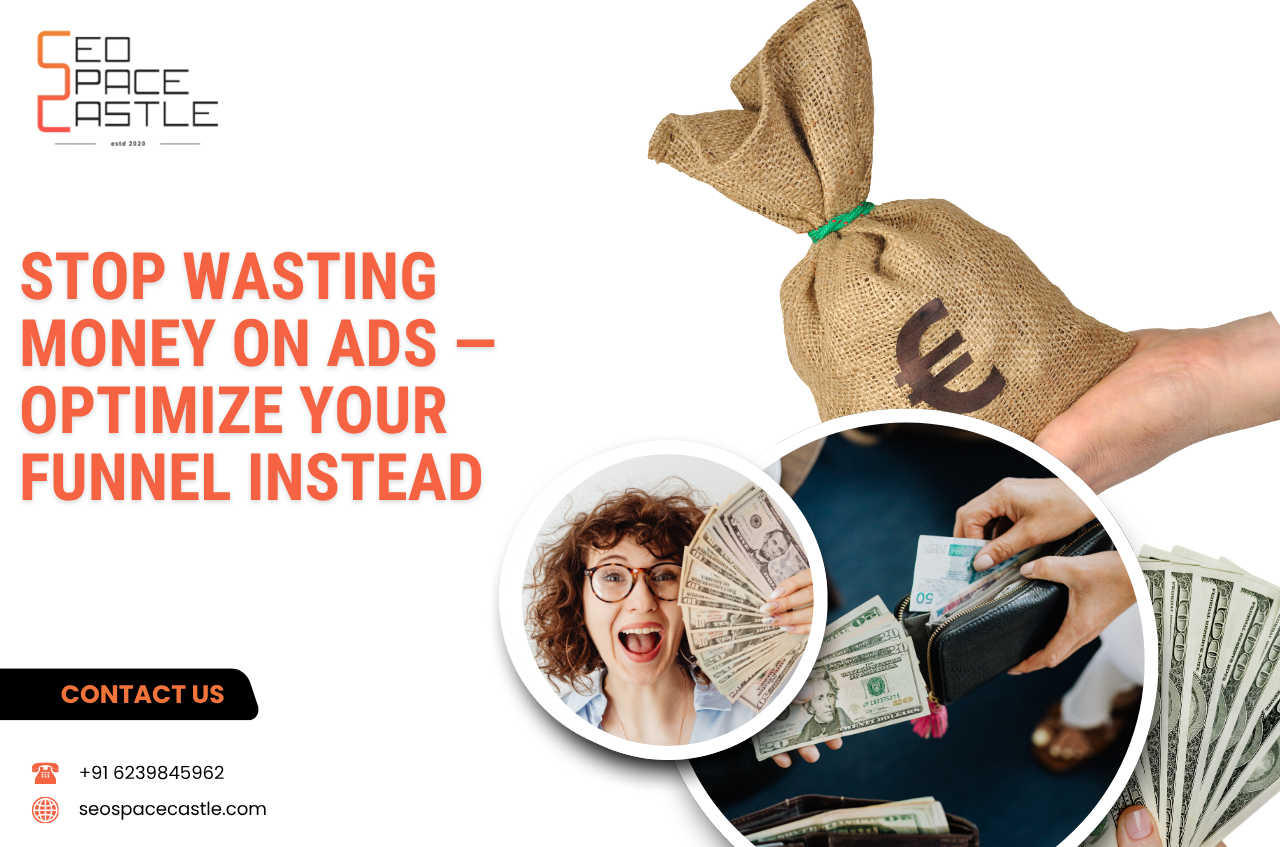
In today's market, the majority of organizations are spending a lot of money on ads, and even less on sales. If the advertising is not working, the organization's response is to return and spend more on advertising. However, this will not solve the problem.
In a vast majority of situations, there is not really a problem with the ads. The only problem is that the marketing funnel is weak, incomplete, or unfit to convert visitors into customers. If you are leaking at one, or more, stages of your funnel, you are simply wasting more money the more you spend on ads.
This is a great opportunity for you to boost your conversion rates, lower your advertising expenditures, and create a long-term gain. Fix your marketing funnel before spending more marketing budget on ads.
Table of Contents
- Why More Ads Won’t Fix Low Sales
- What a Marketing Funnel Should Do
- How to Know If Your Funnel Is Not Working
- Improve the Funnel Before Increasing the Budget
- The Role of Content in a Funnel
- The Importance of Customer Retention
- A Better Use of Advertising Money
- Frequently Asked Questions
- Final Thoughts
1.) Why More Ads Won’t Fix Low Sales
You can now run ads much easier. Anyone can log into Google or Facebook, set a budget, and in just a few clicks you can be sending traffic in a minute or two. The easy part is getting impressions and clicks on your ads. The hard part is converting that traffic to sales.
So when conversions are low, business owners typically assume:
1.) The platform is performance
2.) The audience is bad
3.) The market changed
4.) Ads became too expensive
In reality, either those assumptions are wrong or it simply means:
There is no real marketing funnel strategy in place to move the potential customer from first contact with you to actually buying.
People do not really buy something on the first chance they see it. Customers need to understand value, trust the brand, compare things they buy, see social proof of decision-making and feel good about that decision. If the funnel does not create these experiences, few users will convert even if you get thousands of visitors.
2.) What a Marketing Funnel Should Do
A marketing funnel is not a campaign or a landing page, but is instead an entire customer journey, taking a stranger to a buyer step by step. Advertising will create the traffic, but the funnel is designed to convert it.
An effective funnel should:
1.) Explain value
2.) Build trust
3.) Educate the customer
4.) Remove doubt
5.) Proof authenticity
6.) Direct the user towards action
When the funnel handles those tasks effectively, every rupee spent on educating through advertising becomes a positive return on investment. Your funnel will always be weak if your advertising spend was high.
3.) How to Know If Your Funnel Is Not Working
Your ads may be costing too much if:
1.) You're getting clicks but no traffic.
2.) Users add items to the cart but don't check out.
3.) You have a high bounce rate.
4.) Your leads are consistently not responding or not engaging with you.
5.) Your cost per acquisition is continually increasing.
6.) You feel you need to continually spend more money on ads to create the same outcome.
If you are finding any of these problems, don't blame the ad, blame the funnel experience.
4.) Improve the Funnel Before Increasing the Budget
Prior to expending additional assets to drive new visitors to your website or landing page, first invest in improving the experience of visitors already experiencing the page.
One of the key starting points when it comes to improving the visitor experience is the landing page. Upon coming to a page, a visitor should have a clear idea of what that page offers them, who it is for, and why is it important. If it takes some process of thinking for a visitor to work out what the page is offering, they will leave. A clean and simple landing page will convert better than a page that does not adhere to those factors.
Another factor is the offer itself. Sometimes the issue is not traffic, but again, the offer. If the offer feels flimsy, not urgent, or not valuable, there will not be any enthusiasm for it. A good offer solves a contributing problem that gives a visitor a valid reason to take action and purchase.
Also, most do not buy on the first pass. They need time. This is where follow-ups are valuable. If you are not engaging in some form of email, WhatsApp, retargeting, and valuable content form of follow-ups, you are losing customers that could use a little more information to make a purchase.
5.) The Role of Content in a Funnel
Content is an excellent way to help people navigate the decision process without making them rely solely on advertisements. A content marketing funnel allows you to build trust, educate your audience, and gradually lead them to a purchase. Initially, your content helps people to understand that they have a problem and learn something valuable.
This might be through a blog post, video, or guide. Once people know and recognize your brand, your content can answer basic questions, share information, provide testimonials, and foster trust. This consists of things like case studies, product demos, or webinars.
Finally, when your audience is ready to purchase, high-quality content, like good landing pages, testimonials, clearly stated pricing, or frequently asked questions, provides the confidence necessary to move ahead. If your content is effective, there would be many conversions that would happen without the need for propelling ad dollars.
6.) The Importance of Customer Retention
One of the biggest mistakes that businesses make is thinking that the sale is the end of the conversation. However, the most profitable part of any funnel is repeat business. It is much cheaper and easier to sell to someone who has already purchased than it is to sell to a new customer.
When customers return, they are more likely to purchase more from the business because they are already familiar with the brand, which means that the business can grow more easily without having to spend on ads. There are simple ways to turn one-time buyers into repeat customers, including following up with customers, helpful onboarding, exclusive offers for existing customers, and referral points.
A business focused only on getting new customers through ads will have to spend an increasing amount of money just to maintain its position, while a business focused on retention will be able to grow more consistently and sustainably.
7.) A Better Use of Advertising Money
To comprehend the importance of a funnel optimization, let’s envision two businesses which spend the same amount on ads. One has a below-average funnel and converts only one percent of visitors from their ads. The other has a well optimized funnel and converts three percent of visitors from their ads. The difference in results can be astounding while not spending more money.
This is exactly why the funnel is going to be a higher return on investment before raising your ad spend provides any additional return. Once the funnel is strong, we can raise our ad spend with confidence, and know that the traffic we purchase will convert.
Frequently Asked Questions
Because marketing is a fast-moving landscape. Following top marketing blogs will help you keep up on what's going on, helps you learn real marketing strategies, and avoid costly mistakes from trial-and-error.
Start with Neil Patel or Backlinko. Both do a good job of breaking down complicated elements in SEO in simple words.
HubSpot and Content Marketing Institute is ideal for founders looking to build their brand from scratch.
Aim for about 2 to 3 times a week. Even just a short read will help you keep your marketing strategies sharp.
Yes! All of these are free, regularly updated marketing blogs, and they all contain information you can use immediately.
Final Thoughts
Before you spend more on advertising, ask yourself a few questions. Do you have your funnel structured correctly? Does your landing page immediately make sense? Is your offer strong enough? Are you following up with people who don't convert? Are you using content to build trust rather than expecting someone to purchase right away?
If the answer is no, then your priority is very clear. Fix the funnel first. Then you can invest in ads.
Ads are not the problem. Ads are simply a fuel source. And fuel isn't helpful until you have a vehicle to get it going. A well-built funnel makes advertising profitable, while a poorly-built funnel makes advertising costly.
Build the system. Then buy the traffic. That is the way to achieve consistent and predictable business growth.